

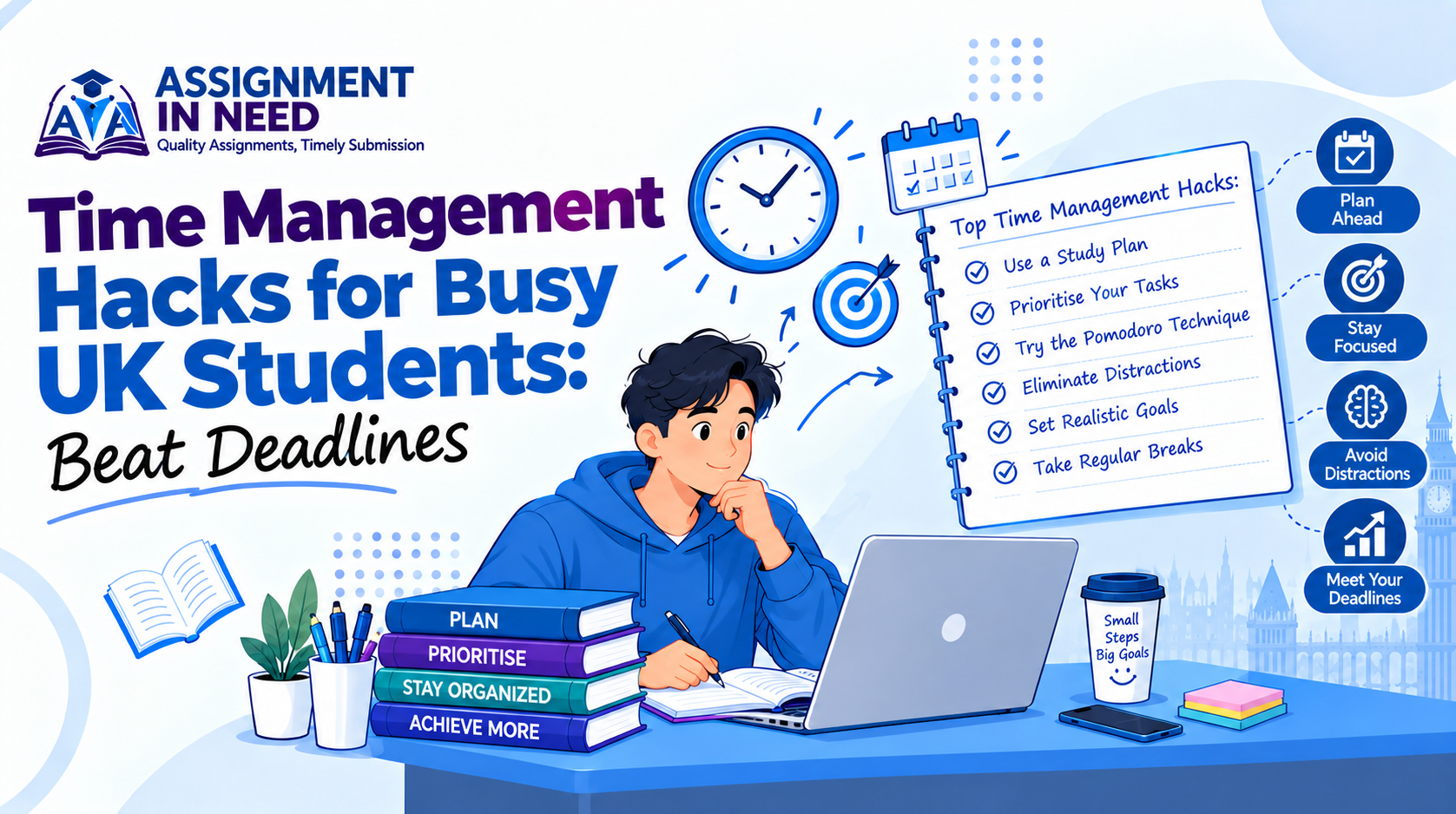
Imagine you have a lecture at 9 am, a 2-hour journey, a part-time job, three unread e-mails, and an essay due in one week. How will time management hacks for busy UK students fit into your schedule? Well, most tips usually advise you to make a longer to-do list. Is it going to help you in a way when you have no power over your schedule? It usually just makes your schedule feel way more stressful. The thing that may help, however, is a few systems that are carefully chosen and fit your schedule, not vice versa.
This is the reason why, in this guide, you will study some time management tips for students that flow around lectures, jobs, and other obligations, without studying every free minute of your day. Each section here follows another one, so think of the following pages as a toolbox.
Quick Guide: Which Hack to Try First?
Not sure where to begin? This following table shows what each hack does and how long it takes, so you can pick the one that fits your week.
| HACK | TIME NEEDED | BEST FOR |
|---|---|---|
| 15-minute time audit | 15 minutes, once | Seeing where your hours go |
| 3-task rule | 2 minutes daily | Staying focused each day |
| Backwards planning | 10 minutes per essay | Big deadlines |
| Fixed-first scheduling | 10 minutes weekly | Students with shifts |
| 20-minute rescue session | 20 minutes | Packed days |
| Sunday reset | 20 minutes weekly | Keeping the week on track |
Why UK Students Run Short of Time?
University life provides you with a set schedule, a long reading list, part-time employment, and social life, all in a city you are just learning to navigate. It can feel like you are juggling five calendars at once, each asking for your immediate attention. Prospects, a careers website for UK graduates, says that goal setting, realistic planning, and saying no determine how well students handle themselves. It does not require a perfect schedule from you; what it requires is some basic habits, and the following time management hacks for busy UK students are sufficiently easy for you to implement right away. If you are a commuter, your challenge is even greater, as traveling takes up time that other students use for studying.
1. Run a 15-Minute Time Audit
You cannot manage something that you haven’t measured; hence, you should become your own detective first. Just observe your activities over an average day and record the actual duration of all activities and circle the activity which will surprise you the most. This approach would be the fastest way to develop time management skill options since it replaces assumptions with facts. The activities to observe would be:
- Lectures and Seminars
- Commute
- Studying and Reading
- Freelance
- Meals and Administration
- Social media, Gaming, and Streaming Activities
- Social life and sleeping
In most cases, students will discover that some of the categories consume much more time than expected.
2. Use the 3-Task Rule
Twelve items on a list seem like a mountain and mountains can easily be avoided. Pick only three priorities from your academic work each day and everything else becomes a bonus. For instance:
- Reading two journal articles.
- Writing 500 words on an essay.
- Reviewing one lecture topic.
According to statistics, the tasks should be chosen based on how urgent, long, and helpful the tasks are in earning marks. This is a great way to pick your three priorities. If you finish early, pick another task from the next day rather than creating new tasks.
3. Plan Backwards from Assignment Deadlines
The deadline is just like a train departing, meaning you will not be at the train station just as the train is leaving. Backtracking from the deadline is something you probably know about, but its success depends on its visual representation. The timeline below helps to manage time as a student if your deadline for an essay is Friday.
| DAY | TASK |
|---|---|
| Sunday | Gather sources |
| Monday | Write the essay plan |
| Tuesday | Finish research |
| Wednesday | Complete the first draft |
| Thursday | Proofread and check references |
| Friday | Submit |
Your individual deadline should then be 24 to 48 hours before the actual deadline. This allows room for technical problems, shift changes in case of extra work and maybe even another round of editing.

4. Schedule Fixed Commitments First
There are some activities that you cannot shift, so consider them to be those big rocks in the jar and put them down first. Flexible activities are like the sand that goes into the empty spaces. This basic division is the basis of good time management skills for students who are working part time.
| FIXED COMMITMENTS | FLEXIBLE COMMITMENTS |
|---|---|
| Lectures and seminars | Reading and revision |
| Work shifts | Essay research |
| Appointments | Gym and social plans |
If there is a shift change within a very short notice period, then you just have to shift those flexible activities while keeping the others intact. For instance, if you are a student having a seminar on Tuesday morning and a shift on Thursday evening, then you will first block these two.
5. Use Your Commute Wisely
Travelling time could become study time, but only if you decide that. While on your way by train or by bus, you could:
- Play back audio lessons.
- Study flashcards.
- Have a look at one scientific article.
- Draw up an essay plan.
- Arrange your schedule for tomorrow (three tasks).
At the same time, some commutes should be entirely devoted to leisure activities. Intentional choice is always better than regret about wasting time just looking out of the window.
6. Try a 20-Minute Study Session
Expecting that ideal 3-hour period will come eventually, one simply waits. But a 20-minute session is also a valuable study time deposit:
- 5 minutes: revise previous day notes.
- 10 minutes: read one section or article.
- 5 minutes: write down main points.
Such sessions maintain your study pace and make difficult things easier. The same method could be used between a lecture and work shift during a short break.
7. Match Tasks to Your Energy
Not all hours are created equally, and hence, a sharp brain in the morning will complete a difficult assignment in 30 minutes that might take an exhausted one many hours to finish. Pair the activities with your levels of alertness. Small time management tips for students like this often make the biggest difference.
| ENERGY LEVEL | BEST-SUITED TASKS |
| High | Essay writing, problem-solving and difficult reading |
| Medium | Note-making and lighter reading |
| Low | Emails, organising references and admin |
If your peak hours are in the morning, then do not use them to read emails. If you still be uncertain about your peaks and troughs, mark each hour of study as high, medium or low energy level for one week.
8. Do a Weekly Sunday Reset
In amongst all of those time management hacks for busy UK students, one thing is for sure – setting aside an hour once per week is one of the easiest habits to stick with. Imagine it as a pit stop before the week commences. Here, Prospects advises to review your schedule, and we have made the process much shorter - taking only 20 minutes:
- 5 minutes: check your deadline dates.
- 5 minutes: add lectures and shifts.
- 5 minutes: identify your top three priorities.
- 5 minutes: allow time for unexpected activities.
Pin the plan where you can easily see it every day, like the lock screen of your phone.
9. Drop Habits That Waste Time
Rest is not a price but an essential part of success. To achieve it, you must swap the following habits for the better ones:
| STOP DOING THIS | TRY THIS INSTEAD |
|---|---|
| Building unrealistic schedules | Plan fewer tasks and leave gaps |
| Multitasking while studying | Work on one task per block |
| Checking your phone constantly | Keep it in another room |
| Saying yes to every invitation | Choose the commitments that matter |
| Waiting to feel motivated | Start with ten minutes |
Protecting your sleep, meals, and rest periods not only ensures consistent focus, but also makes the most of your study time and makes you way more productive.
Final Thoughts
All things considered, time management is not cramming everything into the person’s life; rather, it is making well-thought-out decisions. Small and simple tweaks tend to yield more positive results than drastic changes that do not stick long-term. Each time management plan you have studied above takes just a couple of minutes each day, yet it will positively impact efficiency and will help you balance better between personal life and study. Instead of thinking of these tips as a strict list, consider them more as a menu to adapt to your own needs and study schedule.
Start with using one trick and add others gradually, such as a time audit or 3-task rule. If your assignments keep piling up, it is reasonable to seek assignment help in UK that will offer you proper academic support while ensuring your project’s uniqueness.