


Every message needs a way to prove it arrived safely, and that is exactly what Argyle’s communication cycle explains. This demonstrates how an initial concept can move from one person's mind to another's and bounce back as feedback. The six stages are well-known to most students, but applying them is difficult; hence, students lose marks when writing their essays and during tests. The six stages model was developed by Michael Argyle to illustrate the process of communication as a circular process, not a linear one.
To have a full understanding of Argyle's theory of communication requires examples, barriers, and criticism rather than mere definitions. Here, you will learn about the six stages, feedback, case studies, barriers, comparisons with other models, as well as ways to score better. Let us read on!
What Is Argyle’s Communication Cycle?
Here is a clear Argyle’s communication cycle definition: it refers to the model of communication that consists of the six-stages circle, during which a message is generated, transmitted, received, interpreted, and replied to using feedback. It is not considered completed unless the sender is sure about the receiver’s comprehension of it.
Michael Argyle (1925 - 2002) was an English social psychologist who worked mainly in Oxford. He studied the human behavior in person and its elements such as eye contact, gestures, intonation and social skills. Having observed real-life interactions, he noticed that the failures happen always at certain points but not randomly. The Argyle 1972 communication model, connected with his researches on the interpersonal behavior, offered an easy approach for identifying these points.
The purpose of it is very practical. Dividing communication into stages allows you to determine what exactly happened wrong and fix just this stage. The model remains important due to the complexity of contemporary communication. E-mails, group chats and video calls lack the intonation and provide the delayed feedback, thus leading to misunderstanding very quickly. If you ever need help with assignment questions on this topic, begin your research from mastering these six stages and their connection because you get awarded for this clarity.
The 6 Stages of Argyle’s Communication Cycle (With Examples)
The communication cycle 6 stages that run in a fixed order, and each one depends on the one before it. To make them easy to remember, follow one message from start to finish: a student asking a lecturer for an assignment extension.
Stage 1 - Idea Occurs
Every message begins with a thought, need or feeling. The sender decides there is something worth saying. In our example, the student realises that illness has delayed the essay and decides to ask for more time.
Stage 2 - Message Coded (Encoding)
Next, the sender turns the idea into words, tone, gestures or writing. The student chooses a polite email, uses formal language and mentions exact dates. Vague wording or the wrong tone often causes later failure.
Stage 3 - Message Sent
Now the message travels through a chosen channel, such as speech, email, letter or text. Channel choice matters. The student sends an email because it leaves a written record, whereas a hurried hallway comment might be forgotten.
Stage 4 - Message Received
The receiver must actually notice the message. The lecturer needs to open the email, hear the words or see the gesture. Noise, such as a crowded inbox or simple distraction, can stop communication here.
Stage 5 - Message Decoded
Here the receiver interprets the meaning using their own knowledge, culture and mood. The lecturer reads the email and decides whether it sounds genuine or careless. Different experiences can produce different readings of identical words, so decoding is where meaning is often altered.
Stage 6 - Feedback & Understanding
Finally, the receiver responds, showing how the message was understood. The lecturer replies, granting three extra days and asking for medical proof. That reply lets the student confirm the message landed correctly, and it can also trigger a brand new cycle.
How Information Actually Flows in the Cycle
Although the stages are listed in order, information moves as a continuous loop. Each response becomes the starting idea for the next round, so a conversation is really a chain of linked cycles. Think of a tennis rally: every return depends on the shot before it. This is why Argyle’s communication cycle theory is described as circular rather than linear.
Why Feedback Is the Most Critical Stage
Feedback is the only stage that proves communication worked. Without it, the sender is simply guessing. A nod, a question, a reply or even a confused look tells the sender whether to continue, repeat or rephrase, so errors are caught early.
What Happens When One Stage Breaks
Because the stages depend on each other, one weak link disrupts the whole chain. Here is what each failure looks like -
- Coding fails - the message is vague, so the receiver has to guess.
- Sending fails - the wrong channel delays or loses the message.
- Receiving fails - noise or distraction means the message is missed.
- Decoding fails - the receiver reads a different meaning from the same words.
- Feedback fails - nobody checks understanding, so errors continue unnoticed.
Real-Life Case Studies of Argyle’s Communication Cycle
The following scenarios illustrate where the six processes function and fail in practical environments. Note that each example of communication failure starts with one process and is corrected by simple feedback intervention before any real damage occurs.
Student - Lecturer Communication Case Study
A student sends an email to the lecturer saying “Can you check my essay?” The lecturer interprets it as a request for complete proofreading and rejects it. The student needed feedback about the structure only. Feedback uncovers misunderstanding; the student explains it, and the lecturer agrees to check the plan. A more specific coded message could have prevented this misunderstanding.
Doctor - Patient Interaction Case Study
A doctor gives a medical explanation of the procedure to the patient. The patient nods but does not understand. There is a silent decoding error in the case. Only after the doctor asks the patient to repeat the plan did the misunderstanding become obvious. The method is called teach-back; it is a form of feedback and is widely used to prevent failures.
Manager - Employee Workplace Case Study
“Complete the report soon,” says the manager. The employee decodes soon to be by Friday; but the manager meant tomorrow. Everything is well until the deadline is over. If the employee asked, “Do you mean by tomorrow?” the gap could have been bridged by the feedback. Coding precisely and confirming immediately can solve this very common office scenario.
Digital & Online Communication Example
The team leader puts up a single-word message in the team chat: “Fine.” But what was meant by Fine, as agreed to, was decoded by the employees as irritability. In digital communication where there’s no tone of voice or facial expression, the gap is filled by the receivers’ emotions themselves.
Communication Barriers Mapped to Each Stage
These barriers can occur at any stage in the cycle, and correlating these to the respective stages makes them much simpler to solve. Use the following table as a quick diagnostic tool -
- Stages 1 - 2, fuzzy ideas and vague language: Fix - plan your main idea before you communicate, and use concrete language.
- Stage 2, cultural obstacles: idioms, body language, and polite conventions vary from culture to culture. Fix - use plain language, and learn about the recipient’s conventions.
- Stage 3, channel-specific obstacles: a complicated message is communicated using a quick text or a poor channel. Fix - match the channel to your message, and follow up with written communication.
- Stage 4, noise and distraction: Fix - choose an appropriate time and place, and make sure your message was delivered.
- Stage 5, emotional obstacles: stress, anger, or anxiety can cloud judgment and affect your interpretation of the message. Fix - take a break, relax, and address the issue when you are less emotional.
- Stage 5, jargon and assumptions: Fix - define your terms, and avoid making assumptions.
- Stage 6, lack of feedback: Fix - ask open-ended questions and get the recipient to restate the message in their own words.
Strengths and Limitations of Argyle’s Model
No communication model is flawless, and examiners expect you to weigh both the strengths and limitations. The points below explain why the cycle remains popular in textbooks, and where it falls short when applied to complicated, real conversations.
Key Strengths
- It is simple and easy to remember, which suits exams and quick explanations.
- Its circular design treats feedback as a built-in part of the process.
- The stage-by-stage structure helps you diagnose exactly where communication fails.
- It applies equally well to healthcare, education and business settings.
Genuine Limitations and Criticisms
- It oversimplifies reality, since people often send and receive at the same time.
- It does not show the influence of culture, power or context in detail.
- Noise is not labelled as a separate element, unlike in the Shannon-Weaver model.
- It assumes both people are willing and able to communicate openly.
Argyle’s Communication Cycle Vs Other Models
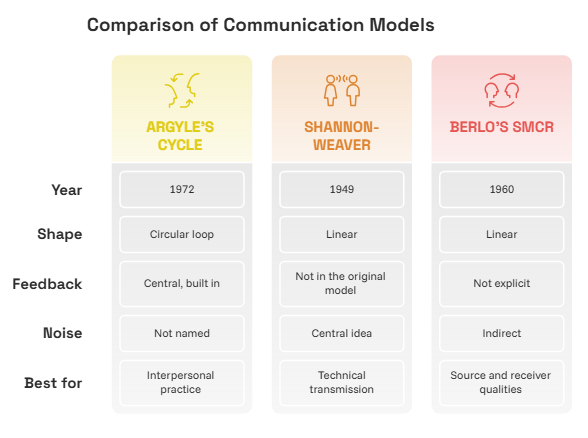
Comparing models shows what this cycle does well and where other theories fill the gaps. The table below gives a quick overview of three famous approaches before the detailed comparison that follows it.
 Comparison with Shannon-Weaver Model
The Shannon-Weaver model of 1949 treats communication as transmission from source to receiver through a channel, with noise as a central idea. It is largely linear and technical, as it was designed for telephone engineering. Argyle’s model, by contrast, is human-centred and loops back through feedback.
Comparison with Berlo’s SMCR Model
Berlo’s SMCR model stands for Source, Message, Channel and Receiver. It focuses on the qualities of each element, such as skills, attitudes, knowledge and culture. It explains why messages differ between people, yet it is less clear about the order of events and the role of feedback.
When to Prefer Argyle’s Cycle
Choose Argyle’s cycle when the question concerns interpersonal communication, feedback or practical improvement, especially in health and social care. Choose Shannon-Weaver for technical noise and channel questions, and SMCR when the characteristics of the source or receiver are the focus.
How to Use Argyle’s Communication Cycle in Assignments & Exams
Examiners rarely want a bare list of the stages from Argyle’s communication cycle. They want application and evaluation, so show how each stage works in a real scenario and where the model has weaknesses.
Common Mistakes Students Make
- Listing the six stages without explaining them.
- Describing the model as linear and ignoring feedback.
- Giving no real example linked to the case in the question.
- Skipping criticism, which limits your analysis marks.
Practical Tips to Score Higher Marks
- Open with a one-line definition, then outline the six stages briefly.
- Apply each stage to the scenario in your question.
- Use a diagram or table, but always explain it in words.
- Mention at least one strength and one weakness.
- Cite Argyle (1972) using your institution’s referencing system.
- If you are unsure about how to proceed, you may seek the help of academic writing websites like Assignment in Need.

Practical Applications for Professionals
Outside the classroom, practitioners use the Argyle’s communication cycle to help improve their conversations. Every stage is turned into a question that they can ask themselves before, during and after a particular communication process.
Healthcare & Social Care
Nurses and carers use the cycle to make sure patients understand advice. Plain language at the coding stage and teach-back at the feedback stage reduce errors, improve consent and build trust.
Education & Teaching
Teachers test the comprehension level of their students through questioning, quizzing, and discussion rather than assuming the lecture was understood. Asking students to paraphrase a particular point in just one sentence uncovers any problems at an early stage.
Workplace & Business Communication
Managers use the cycle to brief teams, confirm deadlines and handle remote messages. Summarising instructions in writing and asking for a quick reply keeps projects aligned, reduces repeated questions and helps everyone leave a meeting with the same understanding.
Essential Insights for Effective Communication
- Communication is a loop, not a straight line.
- Feedback is the only real proof of understanding.
- Every stage can fail, so check each one.
- Match the channel and tone to the message and the receiver.
- Always add examples and limitations in assignments.
Final Verdict
All things considered, Argyle’s model remains one of the clearest ways to understand how messages succeed or fail. It is simple, practical and flexible, even though it gives little attention to noise and context. Learn the six stages, apply them to real situations and always evaluate the model critically. Do that, and you will write stronger assignments and communicate more clearly in daily life.
