


Even the most iconic product loses a potential customer before even trying it. Doesn’t it? The shift from 4Ps to 7Ps of marketing justifies this. It is because the product’s success not only depends on what you sell, but also on things that provoke customers’ buying decisions. For instance, imagine a hotel with affordable pricing and effective promotion, but inefficient staff, complicated booking procedures, and poor quality of the lobby. Clients will be dissatisfied. The gap here is the difference between 4Ps and 7Ps that lies in the extended marketing mix (People, Process, and Physical Evidence).
Having a clear idea of both models is therefore essential, especially for students who are analysing the practical business world and developing marketing strategies. In this guide, you will learn about the 4Ps, the evolved 7Ps marketing mix, compare both models, and see their application through practical examples and marketing strategies. Let’s dive in!
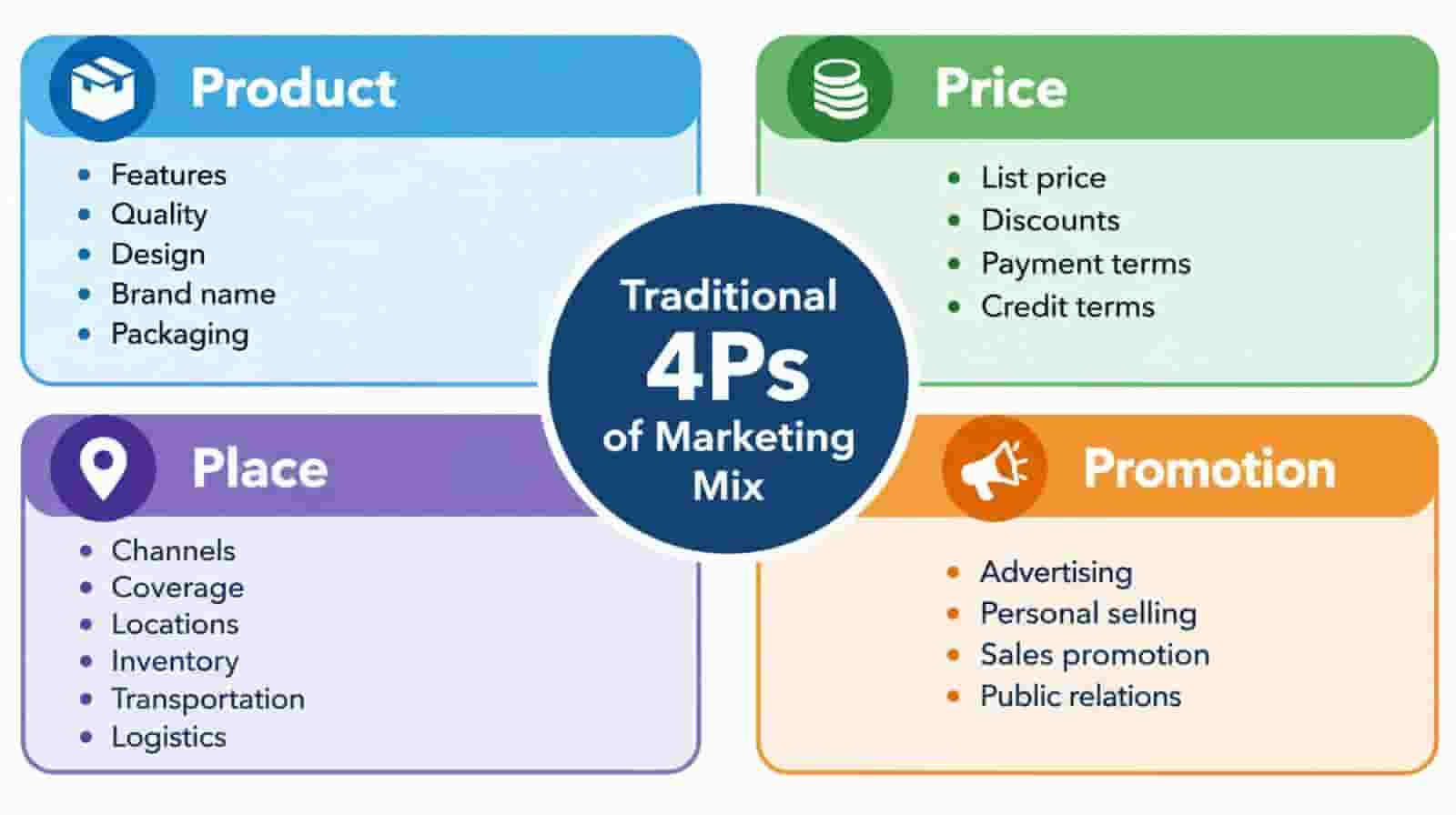
Traditional 4Ps of Marketing Mix
The marketing mix was developed by E. Jerome McCarthy in the early 1960s based on the concept of a mix of marketing ingredients that were popularised by Neil Borden. The marketing mix was presented by McCarthy as a simple, easy-to-remember structure that can be easily used in practice. The 4Ps of Marketing summarize all the major decisions that a business makes when it presents its offer to market and can be remembered as Product Price Place Promotion. As the 4Ps marketing mix is both easy to remember and practically applicable, they are the first marketing mix framework students meet in their marketing course.
It is important to remember that the four components are interdependent. A high-quality premium product will require a high price, selective distribution channels and, promotion. When all four components work well together, the customer receives a consistent message about the brand. Explore these four components below.
Product
Product involves what the firm is offering to sell. This could be in terms of features of the product, quality, design, the brand, and what the product does. An effective product begins with customer needs. Packaging, guarantees, and after-sales services are also part of the product because they influence the worth of the product. Ultimately, product involves when to upgrade, expand, or phase out a particular product in the product line.
Price
Price refers to the cost that the consumer pays but also serves as an indication of value. The price strategy involves the discount, payment terms, credit arrangements, and what the offer is compared to that of your competitors. If the price is very low, the customer might have doubts about the quality of the product; but if it is very high, they would look for an alternative.
Place
Place involves how and where products are available to consumers. This can be an on-street store, an internet-based site, a wholesaler, or all of these at once. Convenience comes into play, with factors such as product availability, delivery, and location. An inaccessible product is unlikely to be purchased regardless of how good it is.
Promotion
Promotion includes any way the organization connects with its target market. Public relations, sales promotions, personal selling, social media marketing, and email marketing all fall under this category. Not only does promotion help reach the target market, but over time it builds credibility as well. The best promotion also ensures the message hits home by matching the communication medium to the target market.
Expansion of Marketing to 7Ps
The 1970s and 1980s were an era of fast-growing services in many countries, making the initial four components insufficient in explaining them. In 1981, Bernard Booms and Mary Jo Bitner came up with three more factors, specifically made for service companies, and thus developed the concept of 7Ps of Marketing. The three new factors, generally referred to as People Process Physical Evidence, added to the marketing mix and made it a complete 7Ps marketing mix. These are applied not only to service businesses but also to product companies because almost all products come with service.
People
People refer to everybody who makes an impact on the customer experience, including the people at the front lines and back offices who sort out any issues behind the scenes. Factors like training, attitude, product knowledge and communication play a significant role. With regards to service, the one providing it is part of what the customer purchases. While a good-natured and knowledgeable team can make a regular offer extraordinary, an indifferent one can ruin months of marketing.
Process
Process refers to the way a product or service is delivered to the customers via a sequence of activities and processes. It includes such things as booking, paying for the purchase, its delivery, complaints handling and after-sale support. Consistent and seamless process minimizes waiting and error and can be seen by customers. Digital solutions such as booking, order tracking, and even chatbot can help to optimize the process and assess its performance.
Physical Evidence
Physical Evidence is the name given to any tangible evidence helping customers to judge something that cannot be touched until the purchase. Reception areas, well-designed websites, branded uniforms, receipts and online reviews are just a few examples such a P in marketing mix.
Why Traditional Marketing Mix Needed to Grow?
The original model made the assumption that the customer’s relation to the company ends when the transaction is completed. This could work fine with manufactured products, but not so well for services. Services are intangible; they are created and consumed simultaneously and their quality may change every time the service is performed. It is impossible for a customer to test the haircutting, consulting or hotel rooms without payment, thus making people rely on the personnel, process and setting that they encounter. The four variables did not reflect any of those factors.
There are several characteristics of services which led to the need for additional factors:
- Intangibility: clients cannot visualize or touch the service before they purchase it.
- Simultaneity: the service is both created and consumed simultaneously, thus employees interact directly with the consumers.
- Variability: the quality varies from one employee, day, or location to another.
- Perishability: an unoccupied chair or unsold appointment cannot be saved and sold afterwards.
The presence of competition, digital media, and changing expectations made the situation even more complicated as experience became equally important as the product offered. It is therefore quite natural that the shift from 4Ps to 7Ps of marketing was made out of necessity.
A Quick Comparison Between 4Ps and 7Ps
The table below sets out 4Ps vs 7Ps of Marketing across the factors that matter most.
|
FACTOR |
ORIGINAL 4PS |
EXTENDED 7PS |
|
Origin |
E. Jerome McCarthy, early 1960s |
Booms and Bitner, 1981 |
|
Elements |
Product, Price, Place, Promotion |
Adds People, Process, Physical Evidence |
|
Main focus |
Physical goods |
Goods and services |
|
Customer relationship |
Largely ends at purchase |
Continues through delivery and after-sales support |
|
Best suited to |
Simple, product-only businesses |
Service-led and hybrid businesses |
|
Main limitation |
Overlooks the customer experience |
Needs coordination across more teams |
A few things that might come in handy:
- The seven 7Ps do not displace the original four, but develop them further.
- The additional three factors play an especially important role when a consumer is not able to evaluate the quality prior to purchase.
- The two models can work together, depending on what products are being offered by the business in question.
On a practical level, many people see the original four factors as a business offer, while the additional three are seen as the means of delivery of that offer. The former defines what a company is offering, while the latter determines how it feels for the customer to acquire the offer.
The Marketing Mix in Real Life: Two Examples
Practical implementation will help understand theoretical concepts better, and the change of 4Ps to 7Ps of marketing can be more easily understood by comparison. The following examples are based on made-up yet real-life companies.
A Product-Led Business Using the 4Ps
Let us consider a company that sells reusable steel water bottles through outdoor retailers and via their online store. In this case, a marketing mix 4Ps analysis is done in the following way:
- Product: A steel insulated bottle in different colors, with a lifetime guarantee.
- Price: middle level - Higher than plastic bottles and lower than luxury.
- Place: Independent outdoor retail stores and online store with tracking of delivery.
- Promotion: Social media activity, sponsoring of festivals and a discount code for new customers.
The customer makes a one-time purchase, uses the product and does not require any more communication, and so the four factors cover most of the marketing activities.
A Service-Led Business Using All 7Ps
Take the case of a private dental clinic and the marketing mix 7Ps analysis will show why the additional three factors are necessary:
- Product: check-ups, hygiene appointments and cosmetic procedures.
- Price: transparent costs with monthly payment options.
- Place: one central location and online appointment system.
- Promotion: search engine listings, patient recommendations and SMS appointment reminders.
- People: dentists, nurses and receptionists skilled at making nervous patients feel comfortable.
- Process: convenient online appointment, fast service and post-treatment communication.
- Physical Evidence: sparkling clean treatment rooms, diplomas, up-to-date equipment and comfortable waiting area.
Even though the clinic offers fair prices and does great promotion, it could fail due to unpleasant environment in the waiting room or unprofessional behavior on the telephone.
As the comparison of the two cases shows, there is a lot of value in the expanded marketing mix. While the bottle producer can rely on its offer and efficient distribution channel, the dentist clinic should pay attention to how patients are treated and how the visit process is organized. The same applies to cafes, banks, universities and online businesses.
How to Apply 7Ps to Your Own Business
The application of this mix should be done systematically and not in isolation. Here is how it should be conducted:
- Describe your customer. Know who he/she/they are and their expectations before assessing any element.
- Audit the initial four. See whether your product, price, place and promotion fit the customer needs.
- Audit your people. Name the people involved in delivering the experience to the customer and find out whether they are trained and authorised to do so.
- Map your process. Trace the entire customer journey, including post sales, and note any delays and sources of confusion.
- Evaluate your physical evidence. Mention all the things your customers will see, touch and read - website, brochures, invoice etc.
- Get feedback. It could be surveys, reviews and customer complaints. The areas where the experience fails the customer's expectations will be exposed.
- Prioritize and fix. Focus on fixing the gaps that matter to the customer. After that evaluate regularly.
When businesses conduct this review when transitioning from 4Ps to 7Ps in marketing, there will be a lot of things that may be missing when they just look at the product.
The choice of using the review in either way does not matter, but the key is making sure that the review is done specifically. This involves avoiding vague terms such as good services by providing specific pieces of evidence such as average wait times or employee training hours.

Turning 7Ps into a Working Marketing Strategy
The real value of a review comes when it results in some sort of action. The transition from the 4Ps to 7Ps of marketing is the first step to take. The next is to set one measurable goal in relation to each of the seven components of marketing, for example:
- Product - increase the number of consumers rating the quality as good or excellent.
- Price - reduce dependency on discounts by ten percent within six months.
- Place - improve availability, for example by offering two different ways of delivering goods or reducing delivery time by one day.
- Promotion - redirect some of the advertising budget into those media that bring in the most loyal customers.
- People - decrease turnover rates among employees and customer satisfaction levels.
- Process - reduce booking and delivery times.
- Physical evidence - redesign the website and signs to ensure that there is brand consistency.
It is also important to recognise the interaction between the elements. The introduction of self-service order entry impacts the Process element, but also alters the People element as people shift from order-taking to problem-solving. The implementation of a loyalty program is part of Promotion, but it requires cards, signs, or application displays, which become Physical Evidence. View the elements as a system as opposed to seven individual elements. Students required to construct such a plan as part of a case study frequently benefit from marketing assignment help to provide references to support their arguments for each objective; however, the best plans always have evidence of the business at its core.
Finally, assign owners to the elements, decide how success will be measured, and review the results every quarter. Such a cycle keeps the strategy realistic and relevant and stops it from being a document that is simply filed away.
Final Thoughts
All things considered, it is important for one to understand the transition from the 4Ps to 7Ps of marketing in order to come up with successful marketing strategies. While the former four (Product, Price, Place, and Promotion) are responsible for laying the groundwork, the latter three (People, Process, and Physical Evidence) add value to the services offered. The latter Ps are particularly important for service-oriented firms, aiming to improve customer satisfaction, gain customer trust, and increase customer loyalty. However, success can only be achieved through the integration of all the seven Ps in one’s marketing strategy.
Businesses should always analyze the expectations of customers, measure their performance, collect feedback, and tailor their strategies to fit market dynamics. Students can seek assignment help to deepen their understanding of marketing principles and explore the concepts discussed above.
